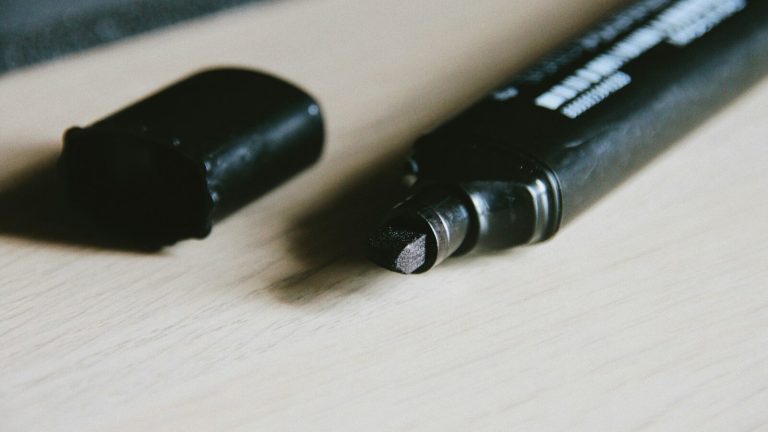
A collection of 60 markers spread across three different cases, caps half-on, stored nib-up in a pencil cup — this is how markers die quietly over months. If you want to know how to store alcohol markers properly, the answer isn’t complicated, but it does matter. Orientation, temperature, capping habits, and your organization system all affect how long markers last and how easy they are to use. This guide covers the practical side of all four.
Key Takeaways
The short version before the full breakdown:
- Store alcohol markers horizontally — it keeps ink distribution even and extends nib life compared to vertical storage.
- Caps are the first line of defense. A loose cap loses ink to evaporation faster than anything else.
- Avoid heat, direct sunlight, and cold storage below 15°C — room temperature is the target range.
- Organize by color family (warm/cool/skin/grey) for collections under 100 markers; add a subsort for larger collections.
- A physical swatch chart is more reliable than any digital reference — make one on marker paper and keep it near your supplies.
How to store alcohol markers (and why it matters)
The single most consequential storage decision is orientation. Most artists keep markers in whatever position feels convenient — pencil cup, vertical stand, upright in a case. Most of these options work against the marker’s mechanics.
Alcohol marker ink is a solvent-dye solution. It doesn’t sit still in the barrel the way paint does — it moves with gravity and evaporates through imperfect seals over time. The orientation you choose directly affects where the ink sits relative to the nib.
Horizontal storage is the standard recommendation because it keeps ink in contact with both nibs simultaneously, distributes the ink evenly across the length of the barrel, and prevents pooling at one end. Markers stored horizontally start evenly and dry out more slowly than the same markers stored vertically.
Temperature matters too. Heat accelerates evaporation even through capped markers — a warm car in summer or a desk near a radiator will shorten marker life noticeably. Cold storage (below 15°C / 60°F) temporarily thickens the ink, causing scratchy initial strokes. Neither is permanently damaging, but both are unnecessary.
Caps are more important than they look. A cap that’s fully sealed feels slightly different from one that’s just resting on the tip. Make sure every cap is pressed firmly onto the marker before storage — this is especially important for rarely-used markers that might sit for weeks between sessions.
Horizontal vs vertical storage
This comparison comes up enough that it’s worth addressing directly.
Horizontal storage
Best for long-term storage and any markers you’re not using daily. Flat trays, dedicated marker storage cases with horizontal slots, and drawer units all work well. The limitation: horizontal storage requires more horizontal surface area, and you can’t see the cap colors at a glance the way you can with vertical.
Vertical storage (nib-down)
Convenient for active working sessions — grab and recap quickly. But nib-down storage causes ink to pool at the chisel tip. Over days and weeks, this saturates the nib faster than normal use, causes excess ink to wick into the paper on the first stroke (the ‘blotch’ problem), and can accelerate nib degradation in cheaper marker lines.
If you use a marker daily, nib-down vertical is acceptable. If you store markers nib-down between sessions spanning more than a day, expect heavier initial strokes and slightly reduced marker life.
Vertical storage (nib-up)
This is the worst option for alcohol markers. Ink runs away from the nib, leaving the tip progressively drier. Markers stored nib-up for extended periods require multiple priming strokes before they produce even color, and they produce faded, scratchy results until the ink redistributes.
The practical verdict: horizontal for long-term storage; nib-down vertical only during an active work session where you’re recapping immediately after each stroke.
Organizing markers by color
Once you have more than about 24 markers, having a consistent organization system stops being optional. Three systems work in practice:
By color family
The most intuitive system for illustrators: group all warm neutrals together, all cool blues and greens, skin tones, greys, and so on. When you’re reaching for the right color in context, this is the fastest system to navigate. Label each section clearly — a piece of masking tape with a marker-written label works fine.
By brand color number
Best for artists who work from color charts and need to find a specific code quickly. Sort by letter prefix (R, B, G, E, Y) then by number within each family. This is the system marker studios and classroom sets often use. It’s less intuitive for visual color searching but very precise.
By frequency of use
Keep the 12-15 markers you reach for constantly on your desk in an accessible container. Store the rest horizontally in a case or drawer. This is pragmatic rather than elegant, but it reduces time spent hunting and keeps your workspace clear. Review and rotate the desk set monthly as your projects change.
For how to organize markers in a physical container, horizontal drawer units (acrylic or plastic) are the most popular option — they let you see colors at a glance while keeping markers flat. Pencil cases and zipper pouches work for travel but aren’t ideal for long-term storage because markers shift position.
Making a swatch chart you’ll actually use
This is the most underrated step in organizing a marker collection. The cap label color almost never matches the actual ink on paper. Digital color charts are accurate for reference but don’t show how your specific batch of ink looks on your specific paper. A physical swatch chart on marker paper solves all of this.
How to make one: take a sheet of marker paper (same brand you use for artwork), write each color code next to a swatch of that color. Work in your color order — by family or by number, whatever your organization system is. The whole process for a 36-marker set takes about 20 minutes.
Keep the swatch chart near your supplies, not filed away. Photograph it and keep the image on your phone — this is genuinely useful when you’re shopping for new colors and trying to identify gaps in your collection.
Update it whenever you buy new markers or refill old ones. An outdated swatch chart is almost as useless as no swatch chart.
For a deeper understanding of how colors relate to each other within your collection, the alcohol marker color theory guide is worth reading alongside this — it explains how to organize not just by code but by tonal family and value relationship, which makes palette decisions faster.
FAQ
Four practical storage and organization questions.
Should alcohol markers be stored horizontally or vertically?
Horizontal is the standard recommendation for long-term storage. It keeps ink distribution even, prevents nib pooling, and reduces drying. Nib-down vertical works for active working sessions if you recap immediately, but return to horizontal for overnight and longer storage.
How long do alcohol markers last in storage?
A properly capped marker stored horizontally at room temperature can last 2-4 years before noticeable ink evaporation. The cap is the biggest variable — even a slightly loose seal causes measurable drying over weeks. Refillable markers like Finecolour extend functional life indefinitely if the nib stays in good condition.
Can I store alcohol markers in a hot car or cold room?
Avoid both extremes. Heat accelerates ink evaporation and can warp nibs. Cold temperatures (below 15°C) thicken the ink temporarily, causing scratchy initial strokes. Room temperature — roughly 60-75°F / 15-24°C — is the ideal environment for both storage and use.
How do I organize a large marker collection?
For collections over 72 markers, organize by color family with labeled sections. For collections over 150, add a secondary sort by value or saturation within each family. A physical swatch chart is essential at this scale — you can’t hold 150 color relationships in memory, and the caps are too unreliable as a color reference.
Final Thoughts
Good storage habits compound slowly. You won’t notice the difference in your first month. But after a year of horizontal storage, tight caps, and room-temperature conditions, you’ll have markers that still perform the way they did when you bought them — while a poorly-stored collection of the same age will have dried tips, uneven ink flow, and colors that no longer match your swatch chart.
How to store alcohol markers is genuinely simple: horizontal, capped, room temperature, organized by a system you’ll actually maintain. The swatch chart is worth 20 minutes of your time. The rest is just habit.
If you’re thinking about expanding your collection, the Finecolour color range is a good place to plan additions — you can browse the full 240-color Sketch and Brush range to identify the gaps in your current palette before you buy.